In today's popular culture, "Voodoo" is often depicted as something evil, something that resembles witchcraft for instance. But it wasn't always seen as such. Originally from what's now the Republic of Benin in West Africa, Voodoo is (in simplest form) a spiritual system centered on God, spirits and ancestors. Voodoo came to America with the arrival of the first African prisoners in the early 1700s. During that time, Voodoo traditions were strictly African. But when slave deportation ended in the 1800s, African influence decreased and Voodoo gained Creole and American influences. To the Creoles Voodoo, with it's one God and many spirits who interceded for humans, bore a strong resemblance to the Catholic Church and the saints. So under Creole influence, Voodoo was merged with the Church (becoming almost an offshoot of the Church).
 Hence it's not unusual to see crosses and statues of the Blessed Virgin amongst the voodoo dolls and potions.
The museum was opened in 1972 by the late Charles Massicot Gandolfo, a.k.a. "Voodoo Charlie." According to family legend, Gandolfo's great-great-grandfather Francois Daubert was saved from from a slave revolt by a slave woman named Jacquinette, who was also Voodoo Queen. As Daubert grew up, Jacquinette became his second mother and gained a dominating role in his life. It is said that through Gandolfo and his museum, Jacuinette's spirit lives on.

This is one of the art pieces from the museum, depicting history's most famous Voodoo Queen: Marie Laueau. A Creole, she blended Voodoo with her Catholic faith, and she was labled a saint by some, a witch by others. Both this and the next picture were painted by Gandolfo.
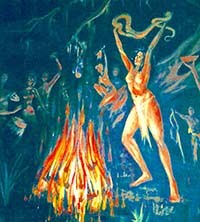 Another piece from the museum, depicted here is a Voodoo ceremony with a participant using a snake. The snake was said to represent one of the major Voodoo spirits, one who was the messanger between God and Man. When Voodoo first arrived in New Orleans, this snake was called "Li Grand Zambi" or "Ouncongo." Later when languages merged, he was called Papa Labas or St. Peter.
